
EU|BIC excellence awards for most impactful programme
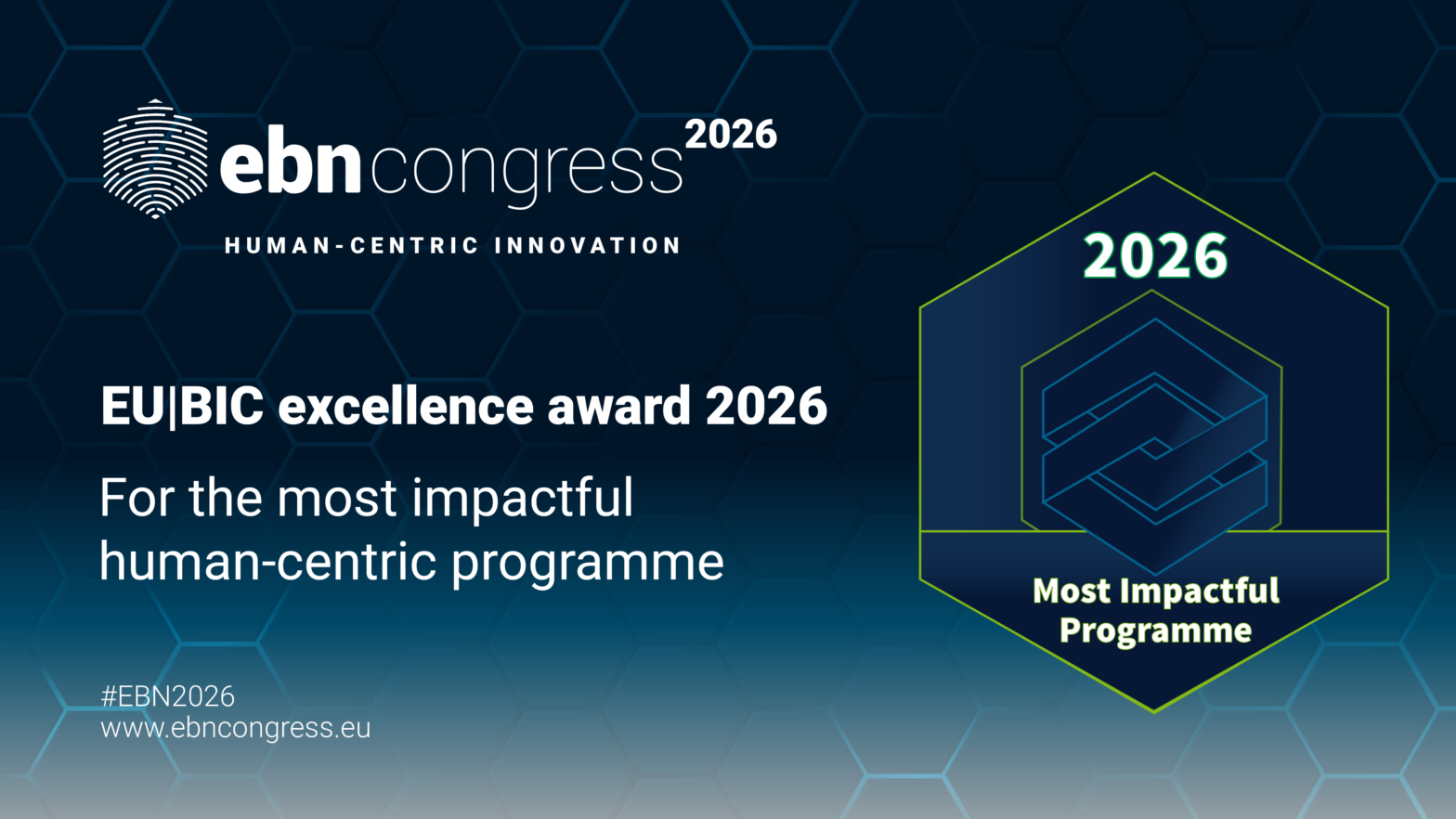
The EU|BIC Excellence Award 2026 recognises EU|BICs that have deliberately designed, implemented, and sustained human-centric approaches. Incubation strategies and programmes dedicated to entrepreneurs’ skills, diversity, inclusion, and wellbeing are under the spotlight of this year’s call for applications.
This Award is about choices, methods, and results:
- Why was a human-centric approach necessary?
- How was it embedded into strategy, services, or operations?
- What changed, for whom, and how can you prove it?
- What can other EU|BICs learn from you?
- How can EU|BICs help European industries centre on human beings, either as beneficiaries or enablers of innovative technological solutions?
Page menu
- Focus of the 2026 Edition: The Human Factor as a Strategic Asset
- What We Are Looking For
- Proposal Evaluation and Selection
- Eligibility criteria
- Assessment Criteria
- Call timeline
- Glossary
Useful information
- For any clarification you might need, please email: Chiara.Davalli@ebn.eu. Please specify “EBN Awards 2026” in the email subject.
- Online Application Form: EU|BIC Excellence Award 2026 | The human factor – Fill in form
- The 5 finalists will pitch their solution on stage at EBN Congress 2026. They will get visibility through EBN channels, including a publication we will release later in 2026
- The winner will be the special feature in the next EBN publication and will benefit from 1 free ticket for their presence at EBN Congress 2027.
Focus of the 2026 Edition: The Human Factor as a Strategic Asset
With this third edition of the EU|BIC Excellence Awards, EBN is showcasing the EU|BIC Community’s implementation of human-centric approaches to innovation, entrepreneurship, and BSOs’ organisational performance.
Across Europe, innovation support organisations face increasing pressures:
- talent shortages and skills mismatches
- accelerating digitalisation
- rising demand around inclusion, wellbeing, and quality of work
- growing complexity in supporting entrepreneurs beyond technical or financial needs
In this context, human-centric approaches are not a “soft add-on”. They are a strategic capability.
The EU|BIC Excellence Award 2026 focuses on concrete incubation programmes or BSOs’ organisational practices that treat the human factor as:
- a design principle, not a slogan
- a lever for performance, not only for wellbeing
- a source of long-term impact, internally and externally
What We Are Looking For
EBN is looking for mature, intentional, and demonstrably impactful practices implemented by EU|BICs that fall into one of the following domains:
Human-centric entrepreneurship
Focusing on tools, methodologies and programmes for incubators’ clients and beneficiaries.
EBN is looking for human-centric innovation and entrepreneurship support programmes. We want to see impact in regional industrial and innovation ecosystems. We are looking for practices that place entrepreneurs, startup teams, or SMEs at the centre. The programme’s design and delivery should demonstrate:
- skills development and reskilling approaches
- wellbeing-aware acceleration or incubation models
- inclusive and accessible support services
- methodologies that strengthen human capabilities alongside business growth
Human-centric incubators
Focusing on EU|BICs’ internal strategies. Think of organisational aspects and processes, placing human wellbeing at the centre to remain effective, resilient, and future-ready.
Human-centric innovation is becoming central in the internal debate of business support organisations themselves. Facing new digitalisation processes and the need for new skills, it is mandatory to reconsider the workplace inclusively. EBN is looking for human-centric incubation management strategies and models that can inspire peers across Europe and beyond. These practices must embed human-centric principles within the EU|BIC, including:
- organisational culture and leadership models
- staff wellbeing, skills development, and retention strategies
- inclusive and diverse workplace practices
- ways of using technology to enhance (not replace) human potential
We are looking for impactful experiences. We are searching for inspiring initiatives proving that technology can increase staff wellbeing and skills, augmenting their innovative and intrapreneurial potential, making the EU|BIC more competitive and effective.
Is your business support organisation embracing such a human-centric approach through dedicated services and programmes for startups and SMEs? Are you taking it into account in your own organisational strategy?
Proposal Evaluation and Selection
All proposals submitted before the deadline will pass an eligibility check (see eligibility criteria) and will go through a 3-steps evaluation process:
- Internal Assessment by EBN team
Each entry meeting the eligibility criteria will be assessed by at least 2 EBN team members who will individually evaluate the proposal according to a standardised scoring system mirroring the evaluation criteria described below. Average scoring of all assessed proposal will result in a preliminary ranking list.
- Collaborative Review Meeting
EBN will convene a collaborative review meeting with EU|BIC Trentino Sviluppo to discuss top 10 applications and finalise assessments. The meeting will lead to the selection of the 5 finalists that will pitch their programmes on stage at EBN Congress 2026.
- EU|BIC Community Decision
The top 5 innovative initiatives will have the chance to pitch their programme on stage at the EBN Congress 2026. They will be able to promote their work and “campaign” for votes. Among the 5, the winner will be selected by the audience present in Trentino and the award will be given during the networking dinner on 18 June 2026.
Communication between the EBN team and applicants during the application assessment process will be carried out primarily via email.
Eligibility criteria
In order to be eligible to apply and participate, applicants must meet the following criteria:
- EU|BIC Membership: Only EU|BIC Community member organisations are eligible to participate.
- Participation at EBN Congress 2026: Only submissions coming from EU|BIC community members attending EBN Congress are taken into account.
Assessment Criteria
Once the eligibility check is performed, the EBN team will review and evaluate the nominations using the following criteria and scoring:
- The need/challenge description > this criterion considers the context in which the programme was developed and implemented, the need they detected and the identified target beneficiaries. (15 points)
- The programme description > this criterion assesses the overall programme innovation, looking at innovative approaches that have clearly put human-centric innovation and entrepreneurship at the centre (the activities, tools, methodologies, structure of the programme, staff involved, focus on skills, etc). (30 points)
- Impact > this criterion assesses the impact generated by the programme, looking at its economic and social outcomes, including diversity and inclusion and stakeholders’ engagement. It also considers a concrete success story of a client/stakeholder who benefited from the initiative. (35 points)
- Transferability > this criterion considers the transferability of the programme (or part of it) to other members of the EU|BIC community. (10 points)
- Communication > This criterion assesses the slide-deck submitted by the applicant to briefly present the programme – max 15 slides in English – and other supporting documents such as video, brochure or other communication materials developed for the programme itself. (10 points)
100/100 is the max scoring.
Call timeline
| Timetable and deadlines | |
| Contest launch | 16 February 2026 |
| Applications due | 31 March 2026 |
| Evaluation | Throughout April 2026 |
| Finalists announced | End of April 2026 |
| Pitching session & Award ceremony | 18 June 2026 |
Glossary
Some keywords of this year’s Award:
- Human centric design: approaches that place people at the heart of innovation, prioritising their needs, experiences, and aspirations to create meaningful and sustainable outcomes
- Customer centricity: solutions designed with a deep understanding of users’ wellbeing and their actual needs.
- Wellbeing: initiatives that support mental, physical, and social health.
- Prosperity: projects that generate societal and economic value for communities.
- Inclusion and diversity: practices ensuring equal opportunities for all, valuing diverse perspectives and experiences.
- Accessibility: removing barriers to participation and ensuring equitable access to technology and services.
- Skilling & re-skilling: programs that enhance workers’ competencies, empowering them to adapt and thrive in a changing world.
Share this post