
CEEI Burgos: 2026 EU|BIC Award finalist
In Burgos, there is a microcredit programme that does something most financial institutions will not. It lends to rural entrepreneurs without collateral, guarantees, or the assumption that a business in a village of 300 people is too small to matter. The loan comes with hands-on technical support from application through to repayment. It is a loan that deeply connects the lender with people and places. Meet the Rural Microcredit Programme, managed by EU|BIC CEEI Burgos for the Provincial Government’s development agency SODEBUR.
Context
Burgos is a province of 14,000 square kilometres, with more than 1,200 villages spread across 371 municipalities. Outside its three main urban centres, its population density is low. There are only 8 inhabitants per square kilometre.
In this context, a single business can be the difference between a community holding together or hollowing out. Traditional banking does not reach these places effectively. The distances are too great, the loan sizes too small, the collateral too scarce. The Rural Microcredit Programme was built precisely because viable projects were not failing for lack of ideas, but for lack of accessible finance.
About the Rural Microcredit Programme
The methodology behind the programme was shaped by the EIF JASMINE capacity building initiative, delivered by the Microfinance Centre and specialist European partners. That training reframed how CEEI Burgos thought about lending, away from collateral-based risk assessment and towards close, continuous contact with the entrepreneur.
CEEI Burgos built risk assessment, project evaluation, and credit proposal tools for their rural reality. Those tools have since attracted interest from organisations in Spain and beyond. Governance is another distinctive feature. The credit approval committee brings together the Provincial Government and SODEBUR, social services, the Confederation of Business Associations, the Young Entrepreneurs Association, the Chamber of Commerce, representatives of mayors, and the six LEADER rural development groups active across the province.
The programme operates as a revolving fund. Repaid loans are reinvested in new projects. This makes the model financially sustainable over the long term.
Impact
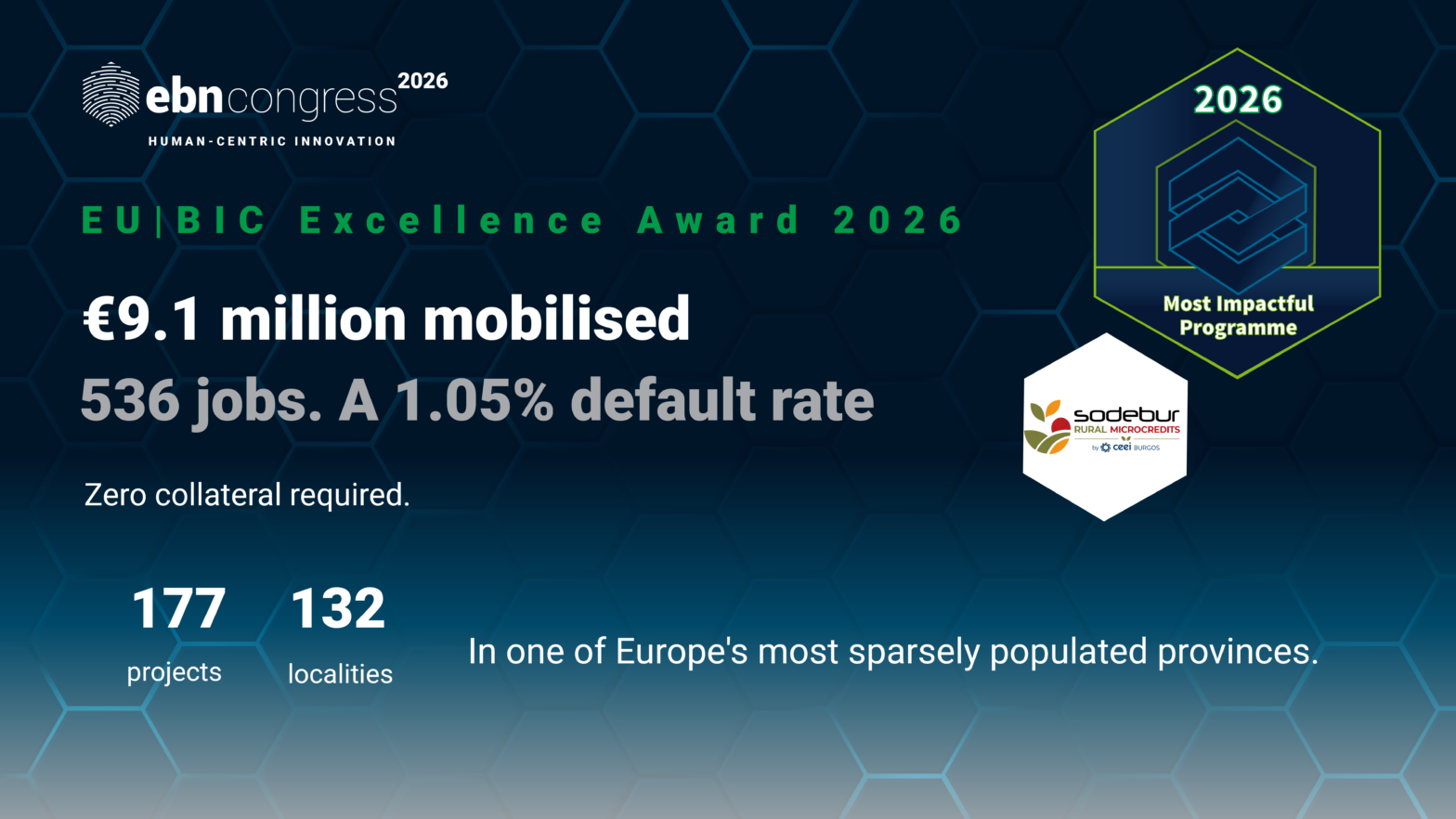
Since 2013, the programme has approved 177 projects from 299 applications, mobilising over €9.1 million from €3.57 million in public loans. They have a leverage ratio of 2.57 to 1. It has created or sustained 536 jobs across 132 localities. Its default rate is only of 1.05%. For context, unsecured rural microfinance typically sees default rates of between 6% and 12%.
The human-centred KPIs are equally strong. Surveys of funded entrepreneurs show an 85% business survival rate and over 80% reinvestment after the loan, with an average reinvestment of €30,210. Around 41% of funded projects are led by women, well above the Spanish rural average of 30% and the European rural entrepreneurship average of 22%. Using OECD and Social Value International methodologies, the programme’s estimated social return on investment is 20 to 1: for every euro of net public investment, around €20 of economic, social, and territorial value is generated.
The programme also specifically reaches youth, new settlers, and migrants: people who chose to stay or arrive in rural Burgos and needed a concrete reason to build their future there.
A story behind the programme
The sectors served reflect the full texture of rural economic life: local services, small industry, agri-food, tourism, and emerging activities. The programme plays a dual role. It catalyses new economic models, introducing digital commerce, smart logistics, and new services to areas that lacked them. It also anchors essential existing services, the businesses that, if they close, leave an entire village without basic provisions.
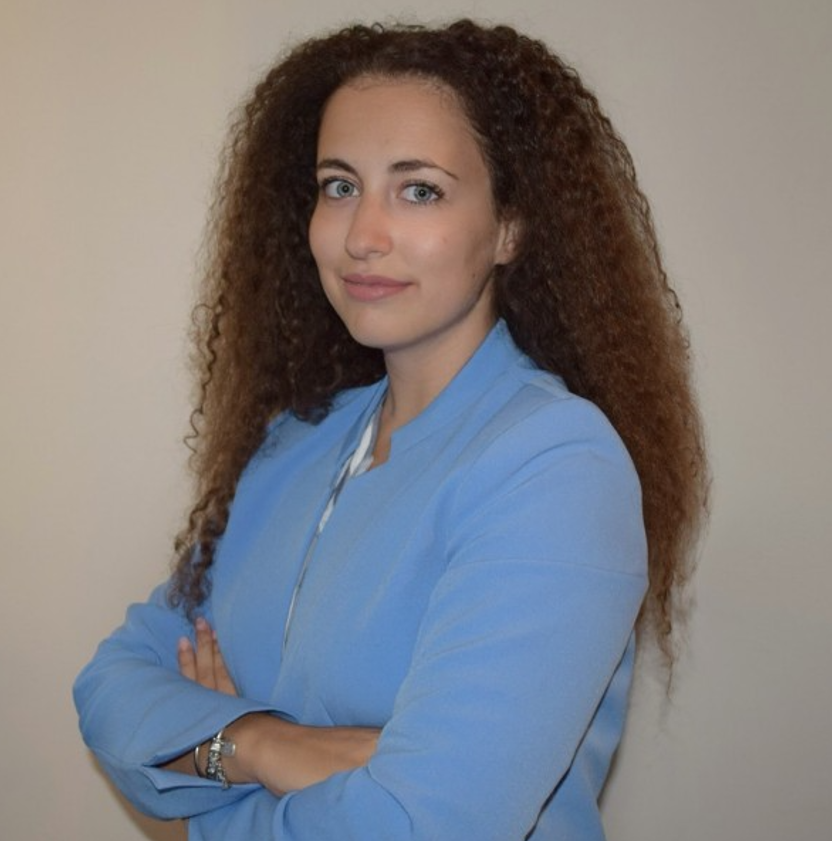
One of those businesses is SAZAM Ingeniería y Mantenimiento Industrial. The company provides specialised industrial maintenance services to local companies. This is an activity in which proximity matters, especially in this large industrialised province. Alba Zamanillo and Daniel Saiz are a young couple who chose to stay in their rural community rather than move to a city for work. To start their business, they needed money to buy equipment. The microcredit made that investment possible. Without it, they say, the project would not have started.
SAZAM has since grown in both turnover and staff, won a provincial sustainability award, and become a trusted supplier to the local industry. As they put it, without this financing, they would not have been able to make the initial investment and start the project.
Future, sustainability, and replicability
Looking ahead, CEEI Burgos plans to maintain annual calls through to 2030, expand outreach in the most vulnerable municipalities, integrate digital tools, and strengthen longitudinal impact tracking.
For any EU|BIC working in a region facing depopulation, ageing, or limited access to finance, the transferable lesson is straightforward. The model does not require large volumes of public money. It requires the right methodology, the right governance, and a revolving fund structure that makes every euro work more than once. The principles can be adapted to different regional contexts. The blueprint, as CEEI Burgos has demonstrated over twelve years, is already written.
CEEI Burgos will pitch the Rural Microcredit Programme on stage at EBN Congress 2026 in Trentino on 18 June. The audience votes for the winner.
Share this post