
Inside the EU|BIC Ecosystem Discovery Mission: What the EU|BICs will find in China
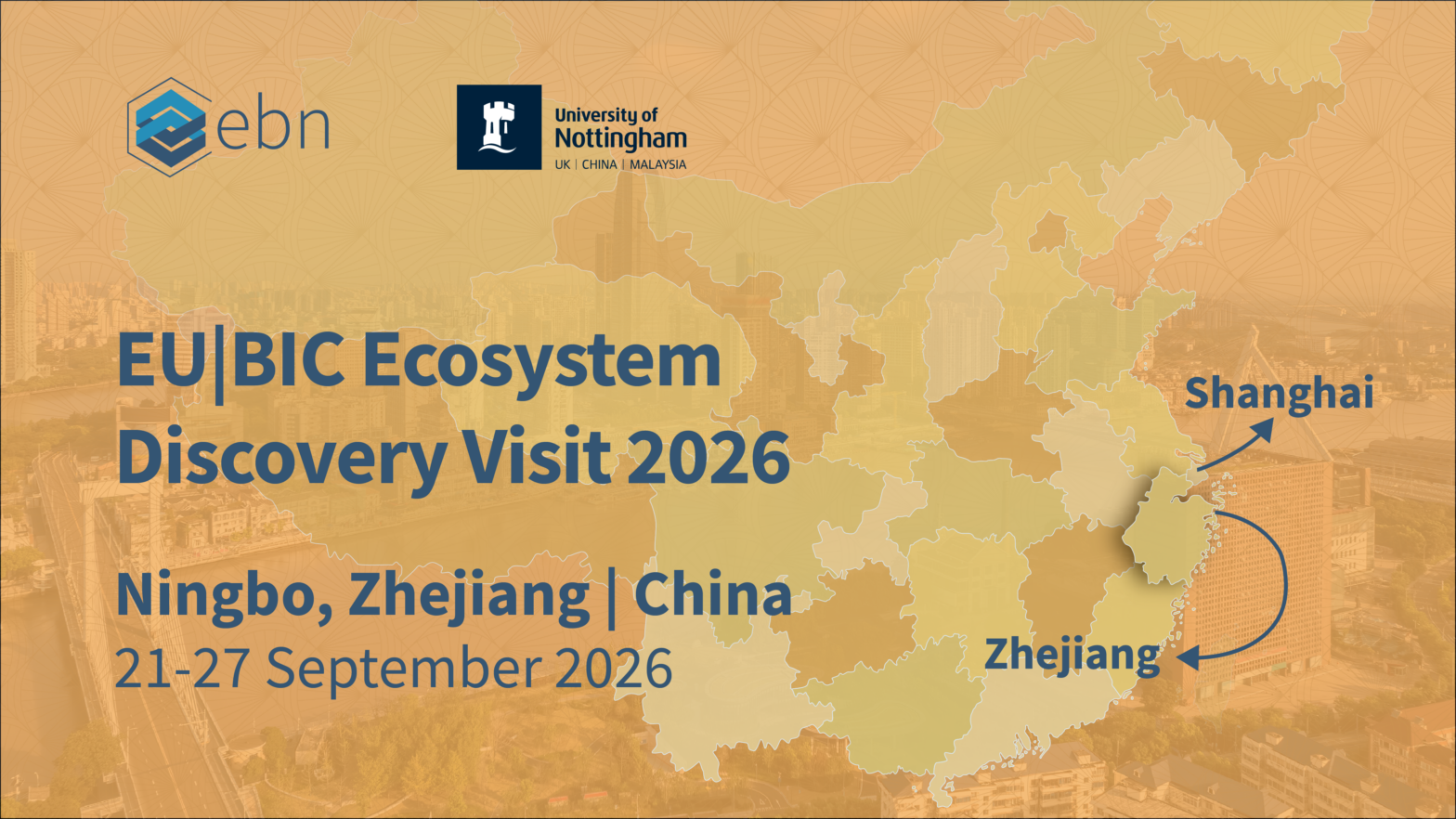
From 19 to 27 September 2026, this is where 20 European innovation organisations will spend a week: not a single city, but a route through four of them.
European companies rarely struggle abroad because their technology isn’t good enough. They struggle because they don’t know which door to knock on, or who can open it.”
Pietro de Martino, President of EBN
For 42 years, the EU|BIC community has answered that question inside Europe. This September it’s testing whether the same approach travels across four hosts: Ningbo, Hangzhou, Wenzhou and Shanghai.
Why Ningbo, China
Ningbo is the delegation’s entry point. Its economy runs to ¥18.2 trillion, China’s 11th-largest, built on manufacturers that already sell into Europe. Geely, owner of Volvo and Zeekr, is based here, alongside Shenzhou International, which supplies knitwear to Nike, Adidas and Uniqlo, and Joyson Electronics, an automotive safety and intelligent-driving supplier.
Ningbo ranks first nationally for “single-item champions,” companies holding the top global share of a specific product category, and fourth for “Little Giant” SMEs, the government’s designation for specialised, high-growth manufacturers. It’s also where the mission’s host is based, which is what makes it the entry point rather than the whole trip.
Ningbo’s port moves more cargo than any other port on Earth: over 1.3 billion tonnes a year. It sits inside the Yangtze River Delta, the region that produces around 24% of China’s GDP and more than a third of the country’s exports, alongside Shanghai and Hangzhou.
Ninety minutes away, Hangzhou gets a full day of its own. This is a ¥2.3 trillion digital economy with 44 unicorns and 230 robotics companies, home to six companies that tech commentators started calling the “Six Dragons” in early 2025: DeepSeek, Unitree, Deep Robotics, Game Science, BrainCo and Manycore. The delegation visits one of them directly, with a site tour and exchange at Unitree Robotics. The same day, they attend the 5th Global Digital Trade Expo, jointly hosted by China’s Ministry of Commerce and the Zhejiang Provincial Government, the country’s only national-level exhibition dedicated to digital trade. Organisers expect 50,000 professional buyers, more than 12,000 of them from over 80 countries, with intended international procurement above US$500 million. EBN’s delegates split into three industry groups there for guided visits and one-to-one matching.
Wenzhou is the one most people haven’t heard of, which is part of the point. Private enterprises make up more than 95% of the city’s businesses, a share unusual even by Chinese standards, and Wenzhou holds 46 national production-base titles, including “Capital of Electric Appliances” and “Capital of Shoes.” Economists call it the Wenzhou model: family-run manufacturing clusters, spanning eyewear, footwear, electrical products and new-energy equipment, that grew almost entirely outside state planning. The delegation spends a full day here, touring Blooms Group and a Plug and Play exhibition and incubation space, then attending an Engagement Event hosted by the Wenzhou municipal government, with pitches from local companies and one-to-one matchmaking of its own.
The mission closes in Shanghai, where Plug and Play China, a startup-corporate matchmaking platform, hosts the final exchange. It’s the broadest stop on the route: less about production capacity, more about how global and Chinese innovation actors work together in practice.
Four cities, four different industrial personalities, reached through one host and one week.
That regional mix maps closely onto what the delegation itself is chasing. Among the 20 organisations travelling, interests range from sensor and hardware manufacturing to biotech infrastructure, construction-project software and supply-chain traceability, a fairly precise match for what Ningbo and Hangzhou actually produce. More on who’s going, and what each wants out of the week, in the next post.
Meet the host: the Li Dak Sum Incubator
Hosting a mission like this only works if both sides can compare notes on the same terms. That’s the role of the University of Nottingham Ningbo China (UNNC) and its Li Dak Sum Incubator, and it’s why Ningbo, not Hangzhou or Wenzhou, is where the delegation lands first.
UNNC opened in 2004 as China’s first Sino-foreign university. It now teaches 10,000 students from 64 countries, and in 2025 its Li Dak Sum Incubator became the first organisation in China to hold EU|BIC certification, operating to the same governance and quality standards as any EU|BIC in Europe.
The incubator runs a five-stage pipeline from early ideation through to company formation and scale-up, backed by seed funding, mentoring and dedicated office space at each step. It has supported 55 incubation startups generating ¥170 million in annual turnover and 131 patents, with ¥5.34 million invested in R&D and ¥4 million secured in government grants. Its International Proof of Concept Centre runs in two stages: a Pathfinder grant of RMB 50,000 to 200,000 for early market validation, and a Translational Fund of up to RMB 2 million (roughly €250,000) for prototype and MVP development, paid against milestones over as long as 24 months. This September, the incubator moves into a new building five minutes from campus, shared with the Ningbo Higher Education Technology Transfer Centre; one of its first tenants is 36Kr, the Nasdaq-listed Chinese tech media and investment platform.
The incubator’s reach already extends well past Ningbo. At Global Pitch, its annual flagship event, keynotes come from Plug and Play China and from the National Innovation Centre par Excellence (NICE), which alone connects 108 research institutes and 680 companies across the Yangtze River Delta, with roughly RMB 12 billion in intended capital contribution. Twenty finalists reach the Ningbo roadshow each year, five from Western Europe, ten from Greater China, five from Southeast Asia, pitching to more than 30 investment institutions and 60 companies, Geely and Sinopec among them. At Global Pitch 2025, UK robotics graduate Haroon Ayub presented the MM2 Panda Robot, a 110cm eldercare companion robot, to over 150 investors and industry figures. Within months, his company, 9i Robotics, had registered a Wholly Foreign-Owned Enterprise in Ningbo and applied for space at the Li Dak Sum Incubator. “Global Pitch was our entry point into the Chinese market,” Ayub said. “[…] Within months, we went from a UK-based startup to having a registered entity in Ningbo, securing local funding, and establishing a clear path to manufacturing.”
Min Rose, Director of UNNC’s Research and Knowledge Exchange Coordination Office, puts the certification in similar terms:
Achieving EU|BIC certification reflects our global ambition: to meet the highest European standards in innovation support and become a trusted bridge between the EU and China.
That shared language is why the route works at all: one certified host in Ningbo, opening doors in three more cities the delegation would otherwise have had to approach cold. It’s the practical form of Mission Commitment 4, Scaling Innovation: EU|BICs and their startups entering new markets through each other’s networks, not alone.
Share this post