
Designing the future of work with people, not around them - EU|BIC Technical Note #12
How the EU|BIC community turns human-centric innovation from a policy into programmes that change people’s lives
Download the Technical Note here
Contribution written by Roberta Cuel, Associate Professor in Organisation Studies, University of Trento, Italy
Megatrends such as socioeconomic and geopolitical challenges, digital transformation, artificial intelligence, the green transition (especially in Europe), and DEI (diversity, equity, and inclusion) are rapidly reshaping how organisations create value and affecting working lives. The decisive factors are how knowledge- and information-based organisations, flexible work arrangements, and new workers’ preferences are taken into account within the organisation, and how they are designed and governed. Human-centred innovation begins with a simple principle: people should not merely adapt to technology; technology and organisations should evolve around human capabilities, needs, and aspirations.
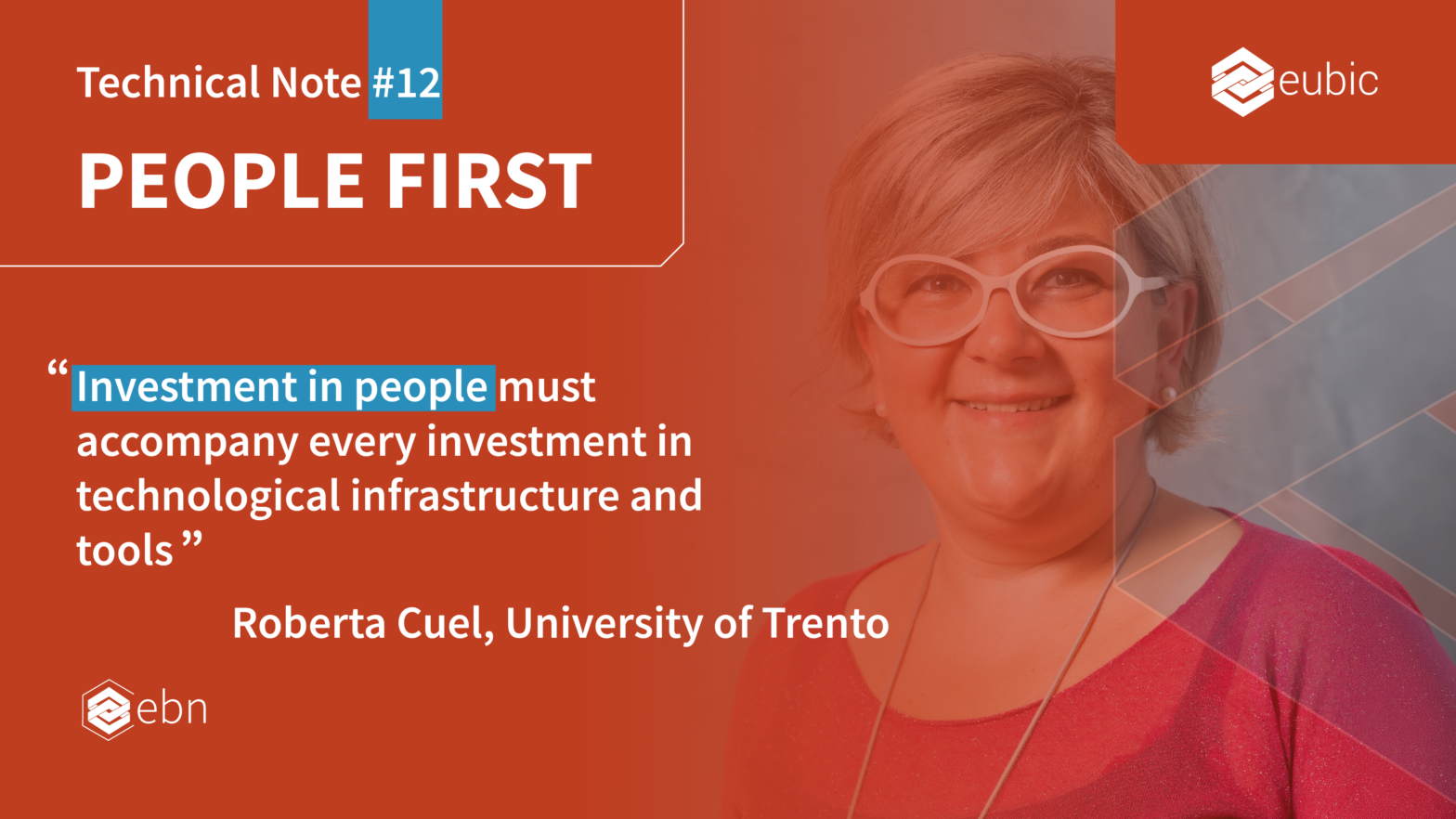
This matters because the nature of work is changing. Routine activities are increasingly automated, while knowledge workers are expected to exercise judgment, collaborate across boundaries, manage uncertainty, and learn continuously. Skills such as critical thinking, emotional intelligence, creativity, leadership, and responsible autonomy are therefore becoming increasingly valuable. Information systems, and in particular AI, can process huge amounts of information at extraordinary speed, but humans remain essential for interpreting context, questioning assumptions, handling ambiguity, and understanding the social consequences of decisions. This is why investment in people must accompany every investment in technological infrastructure and tools.
Technology, and AI in particular, can capture and organise knowledge, recommend relevant content, and support complex decisions. But workers contribute experience, ethical judgment, and contextual understanding. When this relationship is well designed, technology augments human agency rather than reducing people to passive operators.
However, augmentation does not happen automatically. Employees increasingly reshape their tasks, relationships, and ways of working, a process known as job crafting, to make work more effective and meaningful. Organisations should enable this initiative while providing clear responsibilities, psychological safety, and opportunities for collaboration. Here, Human Resource Management has a strategic role. HR professionals are no longer simply administrators of employment practices. They are key players in organisational transformation: translating technological change into sustainable work design, identifying emerging skills, creating personalised learning paths, and supporting people throughout longer and less predictable careers. Investment in training must therefore extend beyond technical proficiency.
A genuinely human-centred approach must also be inclusive. Biased selection systems, unequal access to learning, or poorly designed flexibility can amplify existing inequalities. Fair career paths, transparent rewards, inclusive leadership, and regular equity audits are therefore part of innovation itself, not secondary safeguards.
The future of work will not be made human simply by keeping a person somewhere in the process. It will be human when people can influence that process, develop their capabilities, and find purpose in their contribution. The central question is not how many tasks technology can replace, but what kind of work, and what kind of society, we want innovation to create.
Share this post