
The human value of incubators - EU|BIC Technical Note #12
How the EU|BIC community turns human-centric innovation from a policy into programmes that change people’s lives
Download the Technical Note here
Afterword written by Christian Travier, Director, EU|BIC Laval Mayenne Technopole.
According to its etymology, an incubator is an organisation that nurtures businesses in the process of being created. Its purpose is to help them come to life and then support their growth.
Businesses are driven by entrepreneurs, and nurturing businesses means taking care of the people behind them.
Growing a business means, first and foremost, helping the person behind it to grow.
The journey begins with an encounter. After several months or years of support, when I ask entrepreneurs why they chose our incubator, I am often struck by their answer. It nearly always refers to the human dimension, whether it is the quality of the relationship, the welcome they received, the encouraging smile at the first meeting or the willingness to listen, before they even mention other aspects such as the territory, our reputation or our particular area of expertise.
When recruiting colleagues, I place greater emphasis on their ability to make people feel welcome, their empathy, listening skills, sensitivity and curiosity than on technical knowledge, which can always be acquired later. I then explain that they are about to enter a remarkable profession: helping people change their lives. I sometimes put it more provocatively and say that we are here to change people’s lives. Of course, it is entrepreneurs themselves who decide to change their lives by starting a business, but our role is to enable them to turn that decision into reality by helping them become aware of everything it entails.
Entrepreneurship is a human adventure, a life journey, a personal path before being a job. Supporting an entrepreneur means first taking an interest in them as a person, understanding who they are to better guide them towards the person they will become, without ever forcing them to become someone they do not want to be.
There is no standard mould for an entrepreneur. That is precisely what makes the job of working in an incubator so difficult. It is not about teaching entrepreneurs the basics of accounting or intellectual property, or the fundamentals of marketing or sales. It is about helping them discover how their strengths can serve their project and how their potential can shape their role as a business leader. It is also identifying the weaknesses that may hold them back and that they will need to address, either by developing themselves or by joining forces with others. In reality, the adviser’s role is to reveal the human potential of an entrepreneur in the making.
In June 2026, the French congress of technopoles and incubators was entitled: “ChatGPT – France’s No. 1 incubator by 2030?” Even today, artificial intelligence can already answer most of the questions entrepreneurs ask themselves better than a human adviser can. AI has read more books and more entrepreneurs’ stories, and listened to more podcasts, than any human being ever could. This wealth of material enables it to answer most of the technical questions a first-time entrepreneur might have. So, will incubators still be useful tomorrow?
Even before AI, the adviser’s role was to ask questions rather than provide answers. Being an entrepreneur means building your own path rather than following a route mapped out by others. With AI, this approach becomes even more valuable. Asking questions, challenging, encouraging reflection, helping people question their assumptions, making them aware of their biases, alerting them to subtle pitfalls and enabling them to reconsider their choices are the main tools of the human adviser supporting an entrepreneur.
Entrepreneurs are lonely. The adviser is a neutral confidant, not directly involved in the project yet often knowing more about it than almost anyone else. Listening, empathy, patience and even compassion are invaluable when entrepreneurs are going through difficult times. I remember some extremely difficult moments for certain entrepreneurs when a few supportive but firm words helped them get back on their feet.
Entrepreneurship means patiently building a strong web in which every connection matters: a co-founder, a key partner, a mentor, a business angel, a loyal customer or a high-potential employee are all relationships that can prove essential to the success of a business. We incubated France’s first major crowdfunding platform for charities and non-profits, which has since raised €2 billion, and we introduced its founder to the bank with which he went on to build this remarkable success.
Beyond the intimate relationship between an adviser and an entrepreneur sitting together in an office, the role of matchmaker has always been essential. With the advent of AI, however, it is a role that needs to be developed even further. An incubator must therefore become a powerful hub of expertise and connections, able to identify quickly the right person at the right time for each entrepreneur. Beyond the obvious matches, the adviser must carefully assess whether personalities complement one another, detect potential mismatches that could waste valuable time, and know how to make an introduction in a way that immediately captures the interest of both parties. This matchmaking work can be thankless, because the role of the person who made the introduction is often forgotten by both sides. Yet it is fundamental, because a project can only succeed through the patient construction of a strong network.
In the age of AI, when everything is accelerating and becoming automated, one fundamental truth of entrepreneurship is coming to the fore: the ultimate challenge remains finding customers. Here too, the role of the incubator must evolve and contribute even more actively to identifying and reaching those customers. Helping an incubated company sign a contract is even more important than helping it secure a grant. This ability is above all a human one. An incubator must build the credibility that enables it to open the doors of demanding customers. It must develop a strong network by maintaining weak ties with many people.
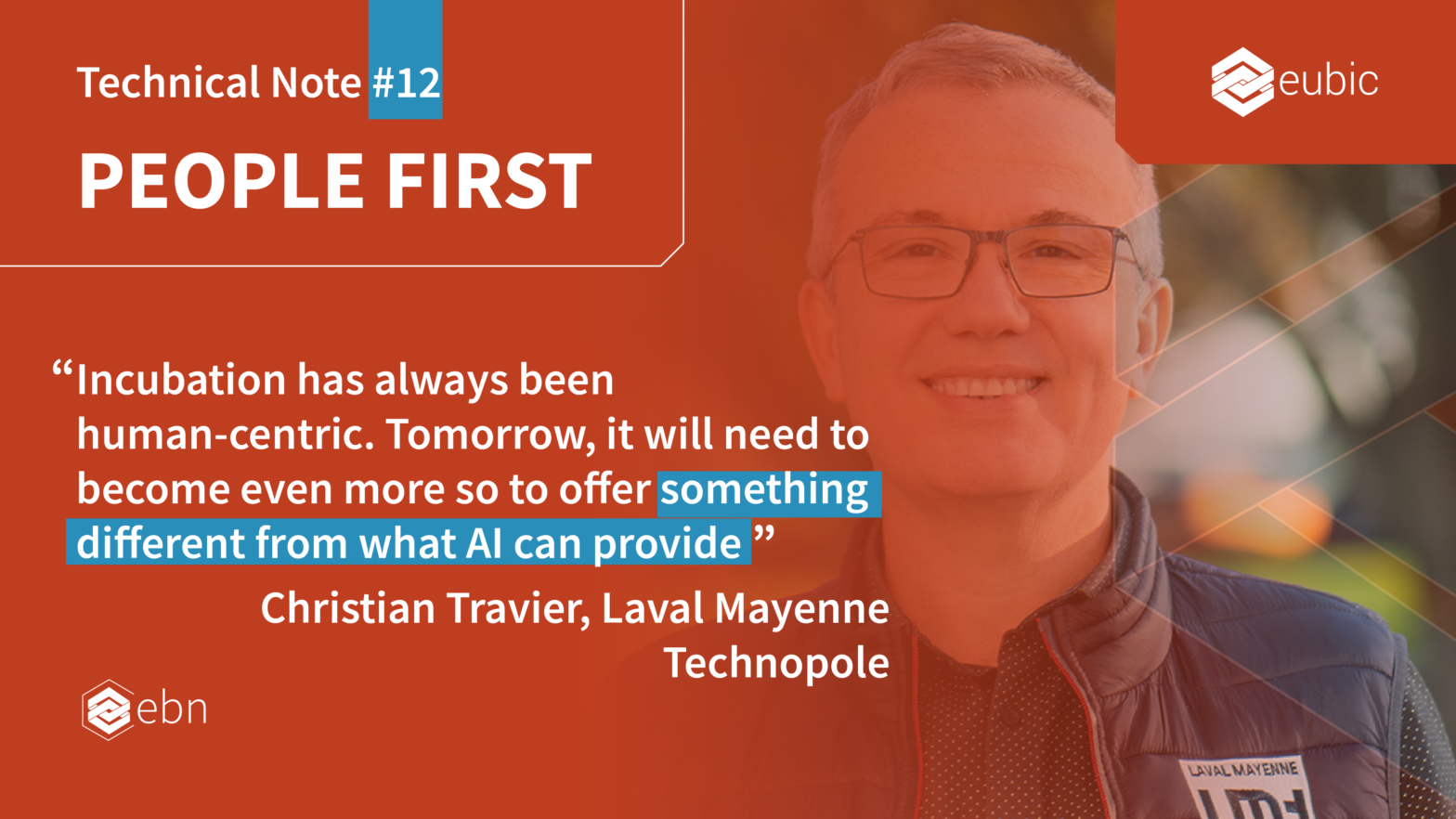
Incubation has always been a human-centric profession. Tomorrow, it will need to become even more so to offer something genuinely different from what artificial intelligence can provide. This means placing greater emphasis on training in coaching, communication, psychology, mental preparation and neuroscience. Because tomorrow, the human qualities of advisers will make the difference when entrepreneurs choose an incubator.
But ultimately, isn’t artificial intelligence pushing every profession to evolve in exactly the same direction?
Share this post